

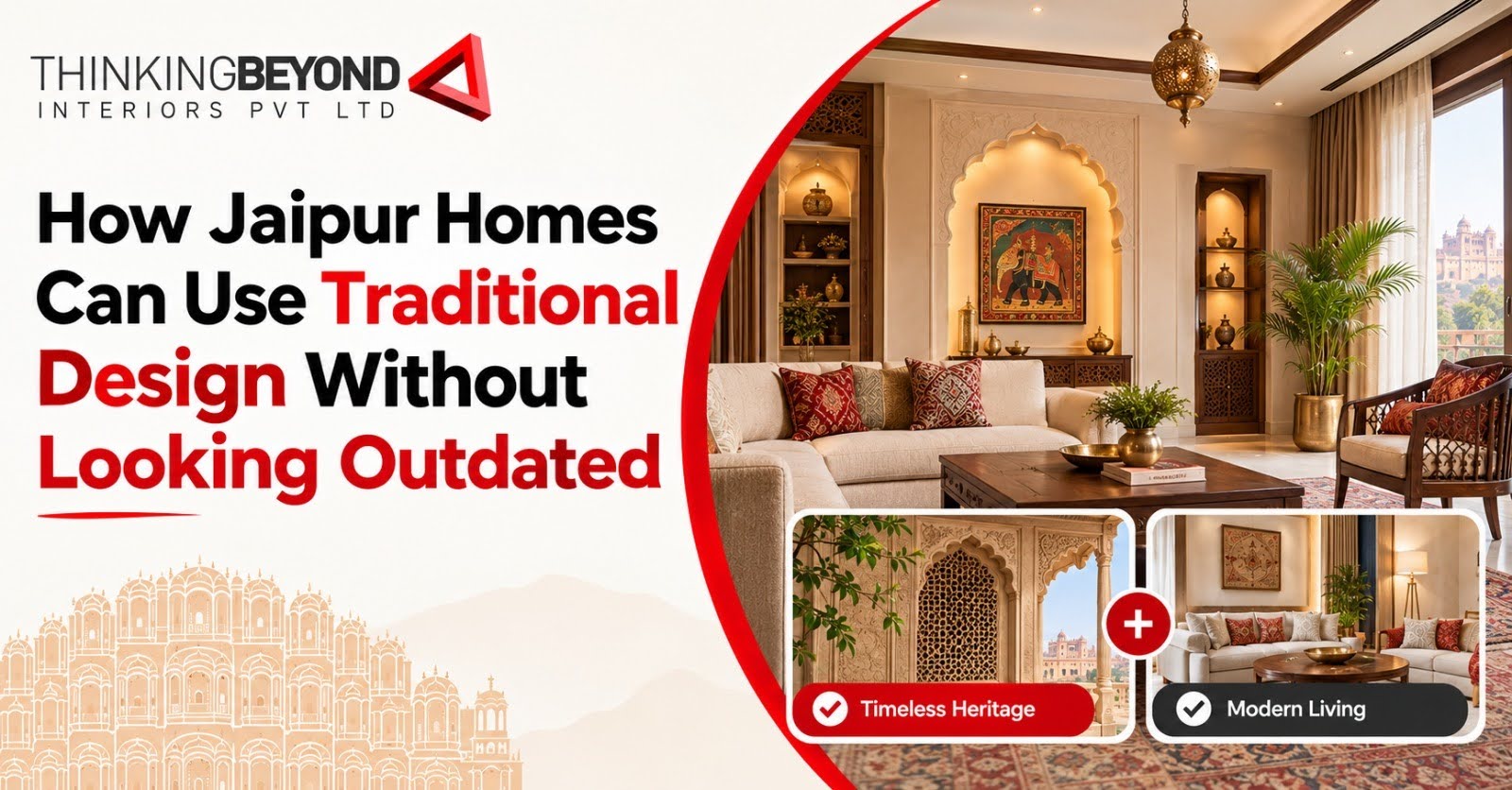
There need not be a conflict between creating a modern or traditional interior inside a house in Jaipur. This is because Jaipur architecture already provides ample vocabulary for visual expression through carvings, hand-crafted furniture, stones, arches, and natural colors.
It’s only a matter of knowing the right amount of tradition to introduce in the interior. Too much décor would make the interior look visually heavy or old-fashioned, and a lack of any cultural element will make the interior look disconnected from its surroundings.
That’s why proper planning becomes imperative in such a scenario. The best interior designers for homes in Jaipur know well that traditional designs perform well if their essence is preserved while their application is done in a contemporary way.
Why Traditional Jaipur Style Is Relevant for Contemporary Home Interiors
Interior styles will always remain up-to-date owing to the fact that they are based on those aspects which do not necessarily rely on fashion. Natural materials, craftsmanship, proportion, texture, and cultural details are able to look elegant even if they are applied with restraint.
In this respect, Jaipur offers great examples of design. Carved wood, colors reminiscent of sandstone, block prints, brass detailing, jali motifs, and handmade fabrics can bring uniqueness to a home even without making it look historical.
A contemporary approach to old style is the selective application of its aspects. Instead of creating a historically styled room, designers can take one element of such an interior and let the rest speak in the language of contemporary furniture and lighting.
How Can Traditional Elements Look Modern in a Jaipur Home?
An arched doorway, for example, can become a clean architectural feature with minimal ornamentation. A traditional jali pattern can be introduced through a partition, cabinet panel, or decorative screen rather than covering an entire wall.
Similarly, carved furniture does not always need to be paired with heavily decorated surroundings. One statement wooden console or handcrafted chair can become the focal point of an otherwise streamlined room.
This approach gives traditional elements visual importance without allowing them to dominate the space.
The Modern Way to Use Rajasthani Colours and Materials
Colour is one of the easiest ways to introduce Jaipur's character, but it needs careful control.
Terracotta, sandstone, muted ochre, ivory, beige, and warm earthy shades can create a connection with Rajasthan without making the interiors feel excessively themed. These colours can be combined with contemporary neutrals to keep the overall environment calm.
Materials should follow the same principle. Natural wood, stone, metal, cotton, and handcrafted textiles can introduce depth through texture rather than excessive decoration.
A contemporary neutral sofa paired with a handcrafted rug, brass lighting, or a traditional textile cushion can often create more sophistication than filling the entire room with heritage-inspired objects.
What Experts Consider When Mixing Traditional and Contemporary Styles
Successful fusion interiors are usually based on proportion, repetition, and restraint.
One of the biggest considerations is deciding which elements will carry the traditional character. If the flooring, furniture, walls, lighting, and accessories all compete for attention, the room can quickly become overwhelming.
A better approach is to create a hierarchy. Perhaps the flooring carries a natural stone character, while the furniture remains contemporary. Or the room may use modern furniture but introduce a carved wooden partition as its defining feature.
The best interior designers for homes in Jaipur typically consider the home's architecture, family requirements, available space, natural light, and maintenance needs before deciding how strongly traditional elements should appear.
What a Real Jaipur Home Can Learn From This Design Approach
Consider a living room with clean-lined furniture, warm flooring, and soft neutral walls. Instead of introducing multiple traditional pieces, the homeowner could add a handcrafted wooden centre table, a patterned Indian rug, and one statement artwork inspired by Rajasthani craftsmanship.
The result still feels unmistakably Indian, but it does not resemble a room designed entirely around a particular historical period.
The same principle can work in bedrooms. A contemporary upholstered bed can sit comfortably alongside traditional bedside furniture, textured fabrics, or a subtle handcrafted headboard detail.
In kitchens, traditional influence can be even more understated. Natural wood finishes, brass hardware, or earthy tiles can provide warmth while modern storage systems and appliances maintain everyday functionality.
What Are the Common Mistakes to Avoid?
The most common mistake is treating traditional design as a checklist of cultural objects. Adding carved furniture, brass accessories, colourful textiles and ornamental patterns all at once does not automatically create an elegant traditional interior.
Another issue is ignoring the scale of the room. A large statement piece that works beautifully in a spacious villa may make a compact apartment feel crowded.
It is also important not to sacrifice functionality for visual character. Traditional-inspired furniture should still support comfortable movement, storage, and daily use.
Finally, copying a heritage aesthetic without considering the home's architecture can create a disconnected look. The strongest interiors interpret tradition according to the space rather than forcing the space to follow a predetermined theme.
How Should Jaipur Homeowners Plan a Traditional-Modern Interior?
Start with the architecture and lifestyle rather than selecting decorative pieces.
Identify the features that already give the home character. This could be an architectural opening, natural light, flooring, ceiling height, or a particular view. Then decide which traditional elements can strengthen those characteristics.
Next, establish a restrained material and colour palette. Choose two or three traditional influences and repeat them subtly through furniture, fabrics, finishes, or accessories.
Most importantly, plan storage, lighting, and circulation before adding decorative details. A beautiful home becomes much more successful when the design also works effortlessly for the people living in it.
This is why choosing the right designer is less about finding someone who can reproduce a traditional aesthetic and more about finding someone who understands how to translate it for modern living.
What Should Homeowners Look for in an Interior Designer?
Homeowners should look beyond portfolio photographs and evaluate how a designer approaches the entire project.
Ask whether the designer understands the home's architecture, listens to lifestyle requirements, considers maintenance, and explains material choices clearly. Experience with both contemporary and traditional styles can also be valuable because successful fusion design requires balance rather than commitment to only one aesthetic.
The best interior designers for homes in Jaipur should be able to explain not only what looks good, but why a particular material, colour, layout, or traditional element works within the specific home.
That distinction can make the difference between a themed interior and a genuinely sophisticated one.
Closing Thoughts
The future of traditional Jaipur interiors is not about recreating the past. It is about understanding what makes traditional design valuable: craftsmanship, warmth, texture, natural materials, and cultural identity, and translating those qualities into spaces designed for contemporary life.
For homeowners looking to achieve that balance, Thinking Beyond Interiors Pvt. Ltd. can help bring together architectural character, modern functionality, and carefully selected traditional details to create interiors that feel rooted in Jaipur while remaining fresh and relevant for years to come.