

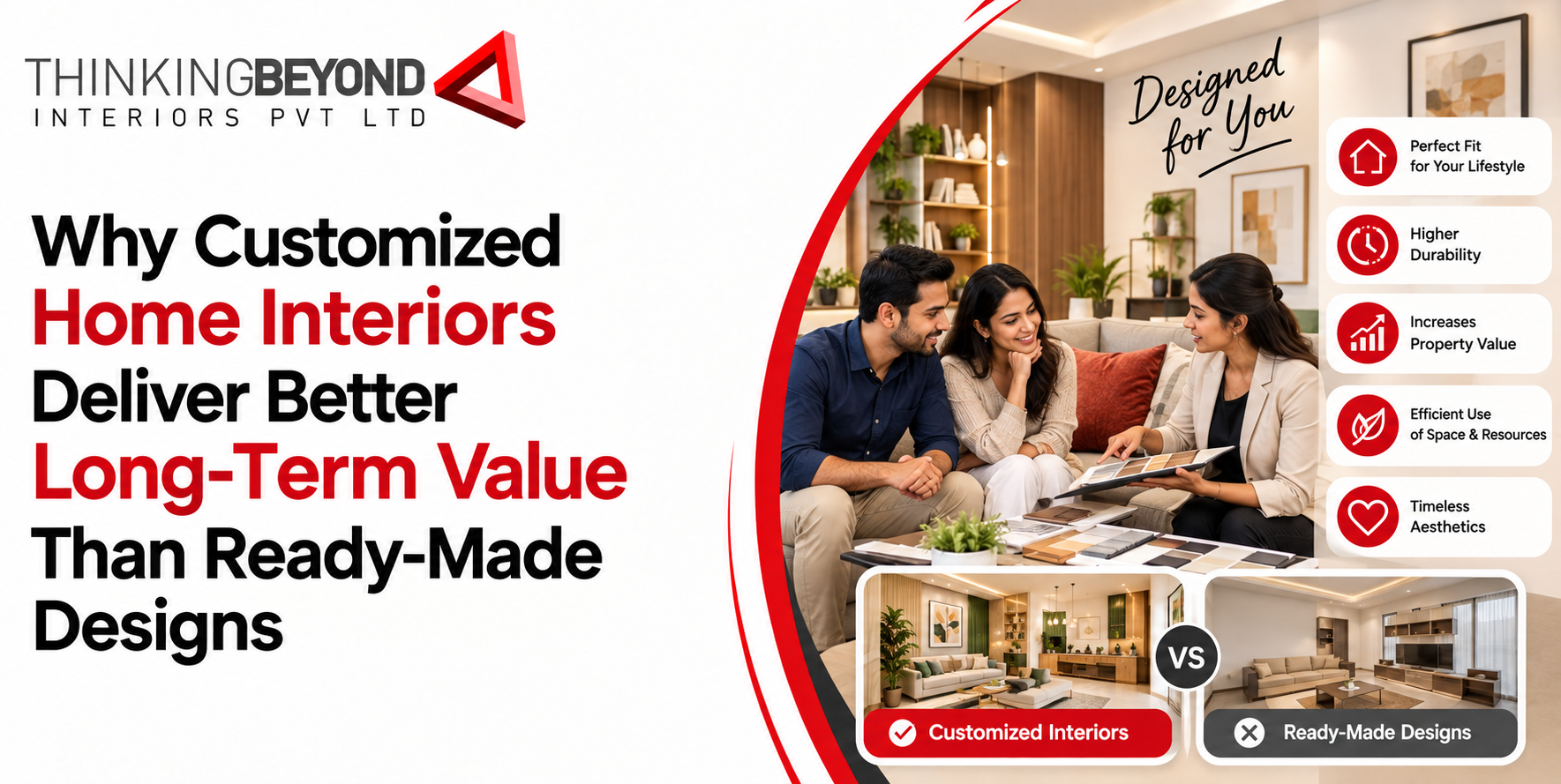
It becomes easy for the person to walk into a showroom, choose from one of the available packages, and come up with an aesthetically pleasing interior design in no time. On the face of it, the process seems simple enough: the colors complement each other; the furniture is modern; and the whole package looks affordable.
However, problems arise once the home starts being inhabited. An unnecessarily spacious wardrobe may leave some empty space; the kitchen might lack the required storage space; or the size of the furniture might make the room look much smaller than originally intended.
Here comes the difference that customization makes. Rather than creating a design to fit a given product, it creates a design that fits the house's architecture, dimensions, and requirements. Many people in India understand the significance of this difference when choosing home interior design services.
Industry Insight
Why Customized Home Interiors Are Relevant
Houses in India come in many forms. There are differences among Indian homes in terms of size, architecture, family structure, storage needs, and living style. The needs of a small apartment and a big independent house will be different. Two houses that have the same floor plan might have different interior requirements since they would have different people using them.
Readymade interior designs are usually created on the basis of common dimensions and layouts. It is easy but not personal in nature.
Today's homeowner wants interiors that would take care of the needs of working from home, smart appliances, storage space, needs of the kids, entertainment needs, and changing living routine. All of this becomes tough with ready-made interior designs.
Customized interior designs for residential buildings are a result of this change.
Expert Commentary
What Makes Customized Design More Functional
Professional interior designers begin by understanding how residents use their home. They consider movement patterns, furniture requirements, natural light, ventilation, storage, electrical points, and the relationship between different rooms.
This planning can make a significant difference in everyday comfort.
For example, a customized wardrobe can use the full height and width of an available wall, including corners that might otherwise remain unused. A modular kitchen can position drawers, cabinets, appliances, and work zones according to the homeowner's cooking habits.
The same principle applies throughout the home.
Experienced designers typically evaluate:
- Room dimensions and structural limitations
- Storage requirements
- Family size and lifestyle
- Furniture proportions
- Lighting and electrical planning
- Material durability
- Maintenance requirements
- Future changes in household needs
The objective is not simply to make every element unique. It is to ensure that each design decision has a practical purpose.
This is an important distinction between genuine customization and unnecessary decoration.
Proof & Real-World Perspective
Customized Interiors Versus Ready-Made Solutions
The difference becomes clearer when both approaches are considered from a long-term perspective.
| Factor | Ready-Made Design | Customized Interior |
| Layout | Standardised | Designed for the specific space |
| Storage | Predefined | Planned around individual requirements |
| Furniture | Fixed dimensions | Custom dimensions possible |
| Personalisation | Limited | High |
| Space utilisation | Depends on standard modules | Optimised for available space |
| Lifestyle integration | General | Specific to residents |
| Future adaptability | Limited | Can be planned into the design |
Imagine a family living in a three-bedroom apartment with one member working from home. A standard interior package may provide attractive furniture but no dedicated workspace. A customized design can integrate a compact workstation into an existing room without significantly affecting circulation.
Similarly, a family with extensive storage requirements may benefit from full-height cabinetry, hidden storage, multipurpose furniture, or intelligently designed utility areas.
These decisions may not always be visible in photographs, but they can significantly influence how comfortable a home feels after several years.
Analysis
Why Customized Interiors Can Offer Better Long-Term Value
Long-term value is not determined only by the initial price. It also depends on how effectively the interior performs over time.
A cheaper solution that requires modifications, replacements, or additional storage shortly after installation may ultimately cost more than a carefully planned design.
Professional home interior design services in India can help homeowners identify these potential problems before execution begins.
Customization also allows homeowners to allocate their budget according to priorities. Instead of spending equally across every room, investment can be concentrated where it creates the greatest practical benefit.
For one family, the kitchen may deserve greater attention. For another, storage and bedroom functionality may be more important. A work-from-home professional may prioritise acoustic comfort and a dedicated workspace.
This flexibility makes customization particularly valuable.
However, customization does not mean every element needs to be expensive. Good design is about making appropriate choices rather than automatically selecting premium materials.
Common Mistakes Homeowners Should Avoid
Several mistakes can reduce the value of a customized interior:
- Customising spaces without considering future requirements.
- Selecting materials based only on appearance.
- Ignoring maintenance and cleaning requirements.
- Designing furniture before confirming accurate measurements.
- Following trends without considering long-term relevance.
- Spending heavily on décor while compromising essential functionality.
A successful interior balances personal expression with practical planning.
Recommendations
How to Decide Between Ready-Made and Customized Interiors
Ready-made solutions can work well for homeowners who prioritise speed, simplicity, standard configurations, or a limited design scope. They can also be suitable when the available space closely matches standard furniture dimensions.
Customized interiors become more valuable when the home has unusual dimensions, specific storage needs, multiple generations living together, work-from-home requirements, or a strong preference for personalised functionality.
Before selecting an approach, homeowners should consider:
Start with the Floor Plan
Understand the exact dimensions, structural elements, windows, doors, and service points before selecting furniture or cabinetry.
Identify Lifestyle Priorities
Think about how the household actually uses each room rather than designing purely according to visual trends.
Plan Storage Early
Storage should be integrated into the design from the beginning. Retrofitting storage later can compromise both aesthetics and usable space.
Choose Materials for Their Purpose
Consider durability, maintenance, moisture resistance, usage frequency, and expected lifespan before choosing finishes.
Keep Future Needs in Mind
A home should be capable of adapting to changing family requirements. Flexible furniture, additional electrical provisions, and adaptable layouts can increase long-term usefulness.
The right design process does not simply ask, "What looks good?" It also asks, "Will this continue to work five or ten years from now?"
Closing Thoughts
The biggest difference between customized and ready-made interiors is not necessarily how they look on the day of installation. It is how well they continue to perform once real life begins.
A thoughtfully customized home can use difficult corners more effectively, provide storage where it is genuinely needed, accommodate individual routines, and adapt to changing requirements. Ready-made solutions offer convenience, but customization provides greater control over how a home functions.
For homeowners seeking home interior designing services in India, the most valuable approach is one that balances personal preferences with thoughtful planning, durable materials, efficient space utilisation, and long-term practicality. Thinking Beyond Pvt. Limited can help homeowners create interiors where design decisions are connected to the way people actually live, making the finished home more comfortable, functional, and meaningful over time.