

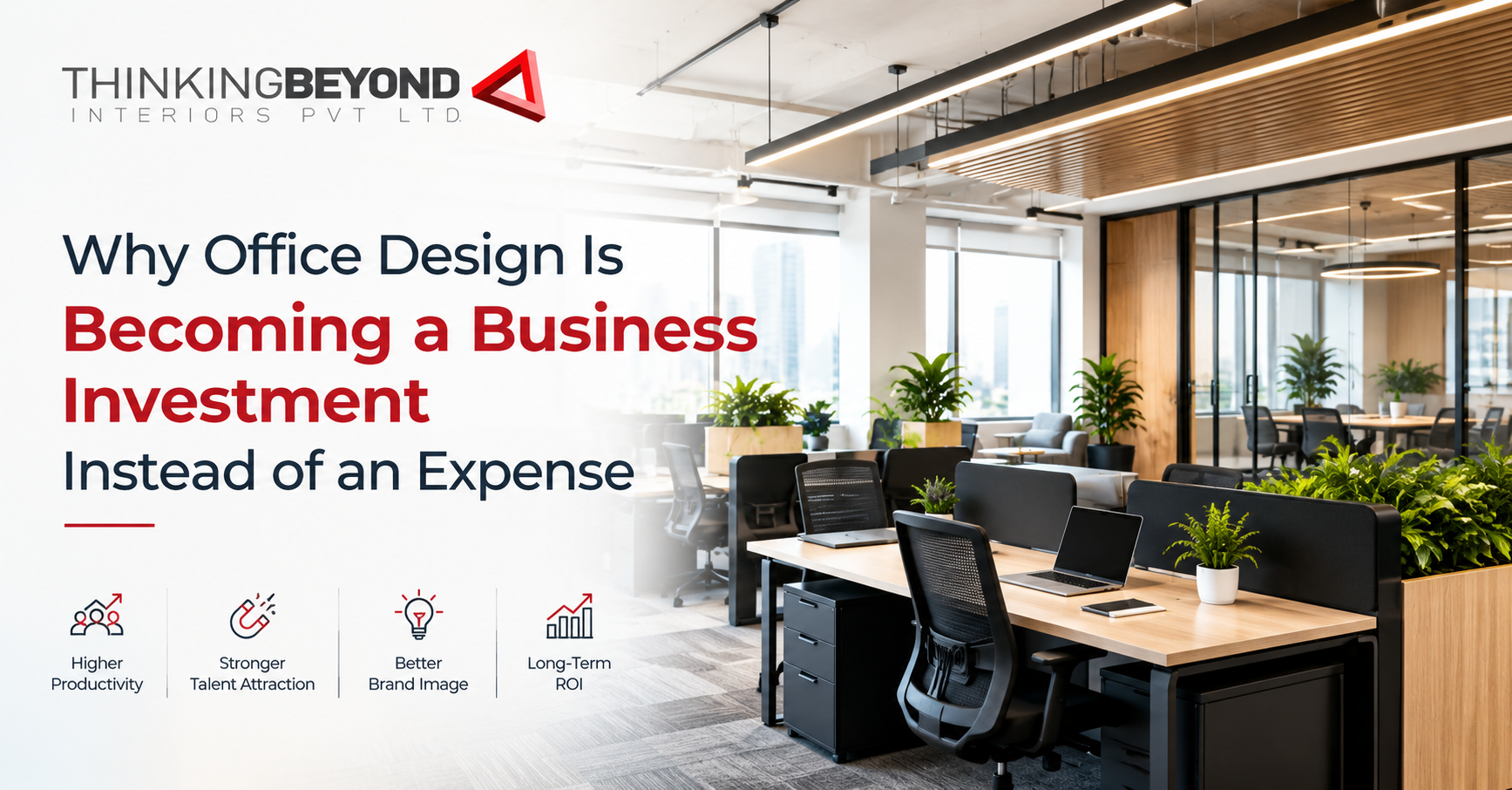
Workplace design goes beyond just the selection of appealing furniture and colors. Companies are starting to see how the design of their workplace can affect various aspects of their operations. This shift is making Office Interior Designing Services in India an important consideration for businesses planning, upgrading, or relocating their offices.
In the case of Thinking Beyond Interiors Pvt. Ltd., efficient office design entails knowing how to use the space and designing the environment based on the needs of the organization. Efficient office design is not just about creating a visually appealing environment; it is about creating a more productive work environment for the business in a smarter way.
Why Businesses Are Rethinking Office Design
Traditionally, office interiors were considered a one-time cost of setting up the office interior. The company would budget for the furniture, partitions, lighting, flooring, etc., put everything in place, and then move on. The traditional method is evolving. These days, companies are taking more consideration of the way their environment supports day-to-day activities. Employees might require spaces for working individually, teamwork, meetings, informal discussions, as well as taking breaks. Also, the clients that visit the firm develop a perception about the company through its environment. This makes office design a business decision rather than an aesthetic one. An office that is well designed will take into account the following elements:
- The effectiveness of the use of space
- Comfort level of employees
- Collaboration among teams
- Capacity of the office to reflect the corporate image of the company
- Ability of the space to be flexible with regard to changes in business process
The issue is moving away from "How should the office be designed?" to "How should the office work?"
How Office Interior Designing Services in India Can Create Business Value
The importance of professional office design lies in the connection between the design elements and business needs. This is different from choosing elements individually because the entire design process takes into account several aspects of design at once.
For example, having a good reception area can create a good first impression, but that is just one element of the entire office experience. If the meeting rooms are wrongly located, the workstations are cramped, and moving around the different departments is difficult, then the office will not function well. Through planning, companies can be able to view their entire office space as a whole.
Office Design Area |
Potential Business Value |
|
Space planning |
Better use of available office space |
|
Workstations |
More practical everyday working environment |
|
Meeting areas |
Better support for discussions and collaboration |
|
Reception |
Stronger professional first impression |
|
Lighting and materials |
More comfortable and visually consistent workplace |
|
Storage planning |
Better organisation and reduced clutter |
|
Brand integration |
Workplace that reflects the company's identity |
The aim is not to increase spending on interiors, but to be smart about investing in components that affect the functionality of the workplace.
Employee Experience Is Now Part of Workplace Planning
Employees spend a good chunk of their time in the office during the course of work, so the environment is a key aspect of the total workplace experience. A bad workplace design will cause frustration for employees because of a lack of mobility, meeting spaces, proper storage facilities, and other inconveniences in the workplace. The best workplace design is one that is made according to the actual needs of the people.
This is one reason why companies are getting serious about planning the workspace. The goal here is not to provide a lavish space just for show. It is to provide a space where employees can do their duties comfortably and where different tasks can be done in the right places. The best office interior designs are functional, comfortable, and practical.
Office Design Can Influence Client Perception
The office environment is an image of the business as well. In the process of visiting the firm, clients, partners, candidates, and other visitors receive their first impressions of the firm from its environment. This means that many things inside the firm's office may speak for the business itself.
This does not imply that each and every firm must have a costly office space. The office design rather should suit the company identity, industry type, target market, and work process. For example, in the case of a professional services firm, the need might be to have a clean and well-organized environment for creating a positive corporate identity. A creative firm might need a more flexible environment.
Why Space Efficiency Matters More Than Ever
The office space is an important element of operations for any company. Hence, inefficient office layouts are completely unnecessary. An efficient workplace layout will analyze employee movement within the office, team placement, use of meeting rooms, and location of storage rooms. One can create an effective office space even without increasing the overall size of the office.
This is where the designer's skills become useful. Rather than just placing desks and chairs in a floor plan, designers can take into consideration circulation, zoning, privacy, collaboration, and needs for the future all at once. This results in an environment that works around its function, not its aesthetics.
Office Interior Designing Services in India Are Moving Towards Business-Led Design
Increased emphasis on business value has also brought about a change in the expectations of interior designers from businesses. It is becoming important for businesses to have their needs known to the interior designers before suggesting any layout or material. The debate is now centered around the following questions: What does the team need? How is the space currently being used? What problems exist in the present layout? How should the office support future requirements? This method allows for the making of more deliberate design choices. Rather than having an even disbursement of funds to all parts of the office space, companies will be able to allocate budgets based on their priorities.
For instance, one firm might require better meeting room facilities, whereas another firm may find the zoning of teams more useful. The investment must always come from a business requirement.
A Well-Designed Office Can Support Long-Term Planning
The office design should not only address current needs. It is also important for businesses to think about future needs that may arise. Groups may grow, departments may relocate, work processes may be changed, and businesses may develop new ways of working. Such changes may make an inflexible design hard to adjust to.
Flexible planning may thus become an integral part of office design. Modular furniture, versatile spaces, sensible storage, and good zoning may help to create an environment that will be easy to adapt in case of changing needs. This is not an attempt to predict the future accurately; it is rather a way to ensure that we do not make design choices that restrict our future options.
From Expense to Investment: What Has Changed?
The distinction between expenses and investments may be made by the value generated in the long run. The office is an increasingly valuable investment when the office design enables the company to maximize the use of space, help employees, create a professional appearance, and remain useful as needs change. The shift below reflects the new thinking:
Old method: Create the office → finish setting it up → use the office. Approach oriented to business: Know business needs → plan workplace → design for people and processes → create flexible long-term value. It is not implied here that all office projects require a big budget. Good design consists of making rational decisions on existing resources.
Why the Right Design Partner Matters
Office design is not just about visual concepts. It requires knowledge about space planning, workplace needs, functionality, aesthetics, and implementation. An appropriate design partner should thus first understand the company before anything else and not start off with interior design ideas. Some pertinent questions for businesses considering office design are:
- Will the proposed design solve our existing workplace issues?
- Is the available space utilized efficiently?
- Does the design match our brand and professional image?
- Is the workplace flexible enough to meet future needs?
- Are the design decisions being made for a purpose?
These questions could move the discussion from internal cost to business value.
Conclusion
Office designs have evolved into a corporate investment as companies go beyond the level of aesthetics. The right kind of office design helps one accomplish the efficient use of space, employee experience, client impression, and other aspects.
Office Interior Designing Services In India must therefore always start with the company itself—in terms of people, processes, brand, space, and needs. Thinking Beyond Interiors Pvt. Ltd., with its practical and goal-oriented strategy, can help organizations look at office interiors not only as an investment expense but also as an essential component of the creation of an effective workspace.
Frequently Asked Questions
1. Why is office design a business investment?
A good office design will come in handy with regard to space management, employee experience, professional image creation, and efficiency at work.
Professional office design is not merely a style choice. It is more of a necessity for doing business.
2. Why is office design essential when it comes to efficient use of the space?
This covers not only the design of the work area and that of the meeting place but also mobility design, storage, collaboration, and many others.
3. Why must a business consider redesigning the office?
This is because businesses have to consider issues like organizational structure, flow of work processes, space available, and many other factors.
4. How do office interior designers improve their design?
These professionals make use of functionality, aesthetics, space, and business needs in order to create good design environments for carrying out business.
5. Do you need an expensive office to create a professional office?
No, one does not need an expensive office for the creation of a professional office. It is all about making design decisions that meet the needs of the business.